
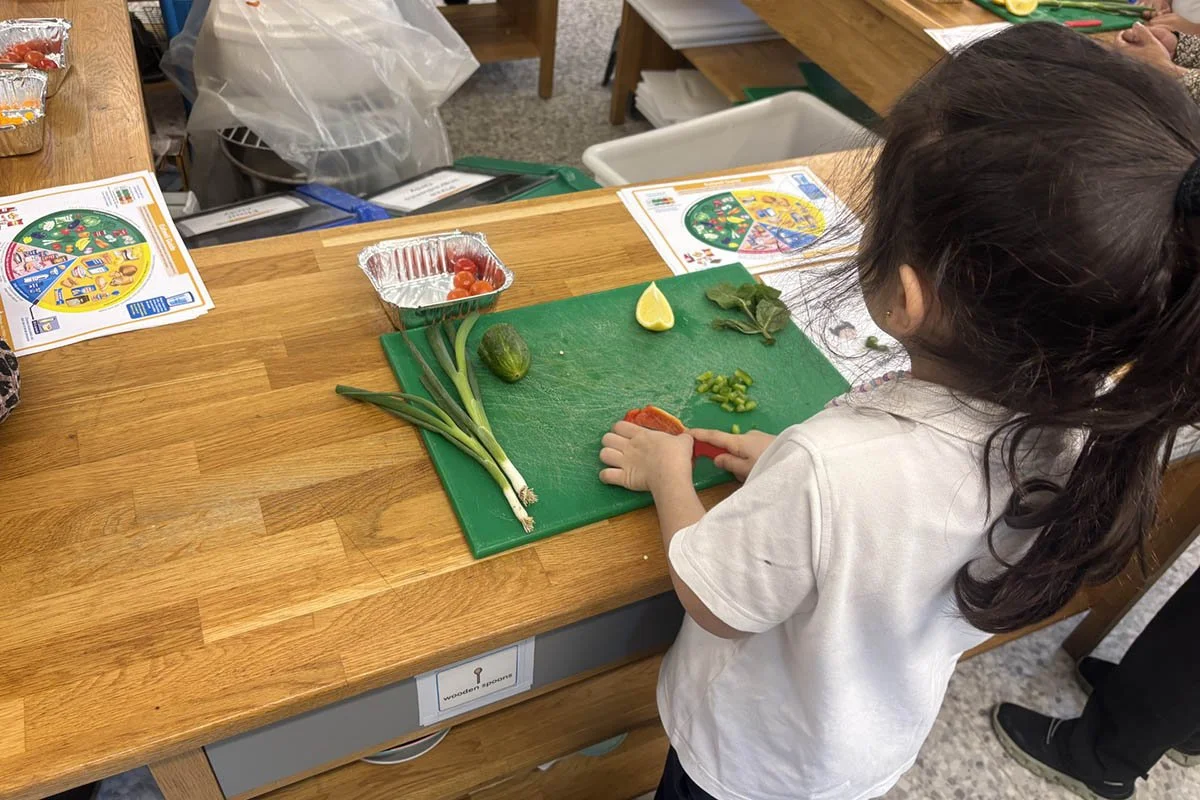
We hosted trainers from Camden who hosted their Family Kitchen programme. This ran after school on Mondays. See their evaluatiob below:
2.0 Healthy Eating Evaluation Results
Evaluation data collected from the three families who completed the programme demonstrated positive changes in dietary habits for both children and parents.
Children's dietary changes
All children (100%) increased their vegetable consumption during the programme.
Three out of four children increased their daily fruit consumption, while one maintained their existing intake.
Overall, every child either increased or maintained their fruit intake.
Consumption of sugary drinks remained unchanged for one child, suggesting further support may be needed in this area.
Parents' dietary changes
All parents (100%) reported an increase in their fruit consumption.
All parents (100%) reported an increase in their vegetable consumption.
These findings suggest that the programme had a positive impact on the dietary habits of the whole family, not just the participating children.
3.0 Evaluation of Behaviour Change in Families
All three families who completed the post-programme evaluation reported positive behaviour changes as a result of attending Family Kitchen.
All families reported eating meals together more often since starting the programme.
All parents stated that they felt more confident cooking with their children.
Parents reported increased awareness of the sugar and salt content of everyday foods and greater confidence in making healthier choices.
Extra feedback on the post evaluation forms:
"We have had so much fun learning new recipes and cooking with each other."
"Thank you for this lovely experience 😊"
"Have learnt more about sugars and salt."
4.0 Evaluation of What Families Learned from Family Kitchen
Families showed an increased willingness to explore and try unfamiliar foods. Parents frequently encouraged their children to be open to preparing, touching, smelling and tasting foods before deciding whether they liked them. This approach increased children's exposure to a wider variety of foods and helped reduce reluctance to try new ingredients.
Peer learning was also evident throughout the sessions. Children were influenced by seeing their friends enjoy different foods, with one child choosing to add spinach to their pizza after seeing a classmate do the same.
The interactive activities were particularly effective in increasing knowledge and engagement. Families responded enthusiastically to the sugar awareness activity and were surprised to discover the sugar, salt and fat content of products such as fruit winders, breakfast cereals, biscuits and takeaway pizzas. These discussions appeared to improve understanding of food labels and healthier food choices.
Parents were especially surprised by their children's willingness to try foods such as dhal after helping prepare them. This reinforced the programme's message that involving children in cooking can increase acceptance of new foods.
The sessions also encouraged healthier snacking behaviours. Children regularly chose to eat raw fruit and vegetables while preparing meals, demonstrating that accessible, healthy snacks can be appealing when offered in a positive environment.
Families' enthusiasm for the recipes was reflected in the fact that many brought containers to take leftovers home, suggesting that the meals were well received and may be replicated at home.